云南大学1.6米多通道测光巡天望远镜顺利通过验收
黄通道、红通道拼接相机通过初验
Multi-channel Photometric Survey Telescope at Yunnan University Successfully Passes Acceptance Review
Yellow- and Red-channel Mosaic Cameras Pass Preliminary Acceptance
2025年11月30日至12月1日,“云南大学1.6米多通道测光巡天望远镜验收评审会”暨“云南大学1.6米多通道测光巡天望远镜黄通道、红通道拼接相机初验评审会”在丽江高美古天文观测站召开。来自上海交通大学、中国科学院国家天文台、中国科学院云南天文台、中国科学院紫金山天文台、中国科学院南京天文光学技术研究所、中国科学院空间应用中心、中国科学院上海技术物理研究所、中国科学院西安光学精密机械研究所及云南大学的相关专家出席会议。望远镜验收评审会和拼接相机初验评审会专家组组长分别由上海交通大学景益鹏院士和云南天文台白金明研究员担任。云南大学副校长唐年胜教授出席验收会并代表学校作重要讲话。出席验收会的还有云南大学一流办等相关职能部门。
11月30日上午,评审专家组听取了国家天文台拼接相机研制项目组所作的《云南大学梦飞多通道测光巡天望远镜拼接相机研制报告》《云南大学梦飞多通道测光巡天望远镜黄通道拼接相机测试报告》《云南大学梦飞多通道测光巡天望远镜红通道拼接相机测试报告》《云南大学梦飞多通道测光巡天望远镜拼接相机在站测试报告》,并就有关技术细节进行了质询和讨论。专家组一致认为,拼接相机研制项目组已完成黄通道、红通道拼接相机的研制工作,以及实验室测试和在站初步测试工作,整体性能达到合同约定的技术指标要求。专家组建议项目组按计划推进后续更新迭代,完成终验。
11月30日下午,评审专家审定通过了《云南大学1.6米多通道测光巡天望远镜现场测试大纲》,并成立现场测试组。当晚,现场测试组依据测试大纲对望远镜进行了现场测试,形成了测试报告。
12月1日上午,专家组听取了中国科学院南京天文光学技术研究所项目组所作的1.6米多通道测光巡天望远镜研制总结报告、现场测试组所作的测试报告,并查阅了相关技术资料和档案文件。经认真讨论和评议,专家组认为,项目组已按照合作协议要求完成了1.6米多通道测光巡天望远镜的研制任务,各项性能指标满足协议要求,一致同意1.6米多通道测光巡天望远镜通过验收。
1.6米多通道测光巡天望远镜(梦飞巡天望远镜)是云南大学“双一流”建设重大科研平台,是国际上首台集大视场、大口径、多通道高精度成像于一体、可拍摄动态宇宙“真彩色纪录片”的巡天望远镜。望远镜主镜口径1.6米,视场3.14平方度,其独特优势在于可同时在三个波段拍摄图像,提供超高精度天体测光及颜色数据。
项目于2018年1月正式立项,经过数年艰苦研制,克服疫情影响,2022年10月覆盖1/4视场的先导系统在丽江高美古台址完成在站安装,实现蓝、红双通道初光;2023年12月,首次获得蓝黄红三通道同时拍摄的天体图像,发布国际首帧真彩色天图,得到媒体广泛报道,引发学界和公众高度关注。“梦飞巡天望远镜发布首帧国际真彩色天图”入选2023年“云南大学十大科技进展”。2024年启动先导巡天,完成1000余平方度天区的多波段扫描,对标准星(场)、多个变源暂现源(超新星、潮汐瓦解事件候选体、AGN、变星等)、近邻星系开展多历元多波段同时观测,开展多个国际合作和科学研究工作,基于获取的数据,产出首批科学成果,已有多篇学术论文在国际天文学顶刊发表,发布GCN快速暂现源通报50余个。2025年9月至今,完成望远镜全视场光学系统及三台拼接相机在站安装,进行了全系统光学精调。
1.6米多通道测光(梦飞)巡天望远镜的建成,使云南大学拥有了国内高校最先进、可与国际一流高校比肩的大视场巡天设备。它的建成,将极大地提升云南大学天文学科的原始创新能力,为建设世界一流天文研究中心,培养高水平天文实测后备人才发挥重要的作用。

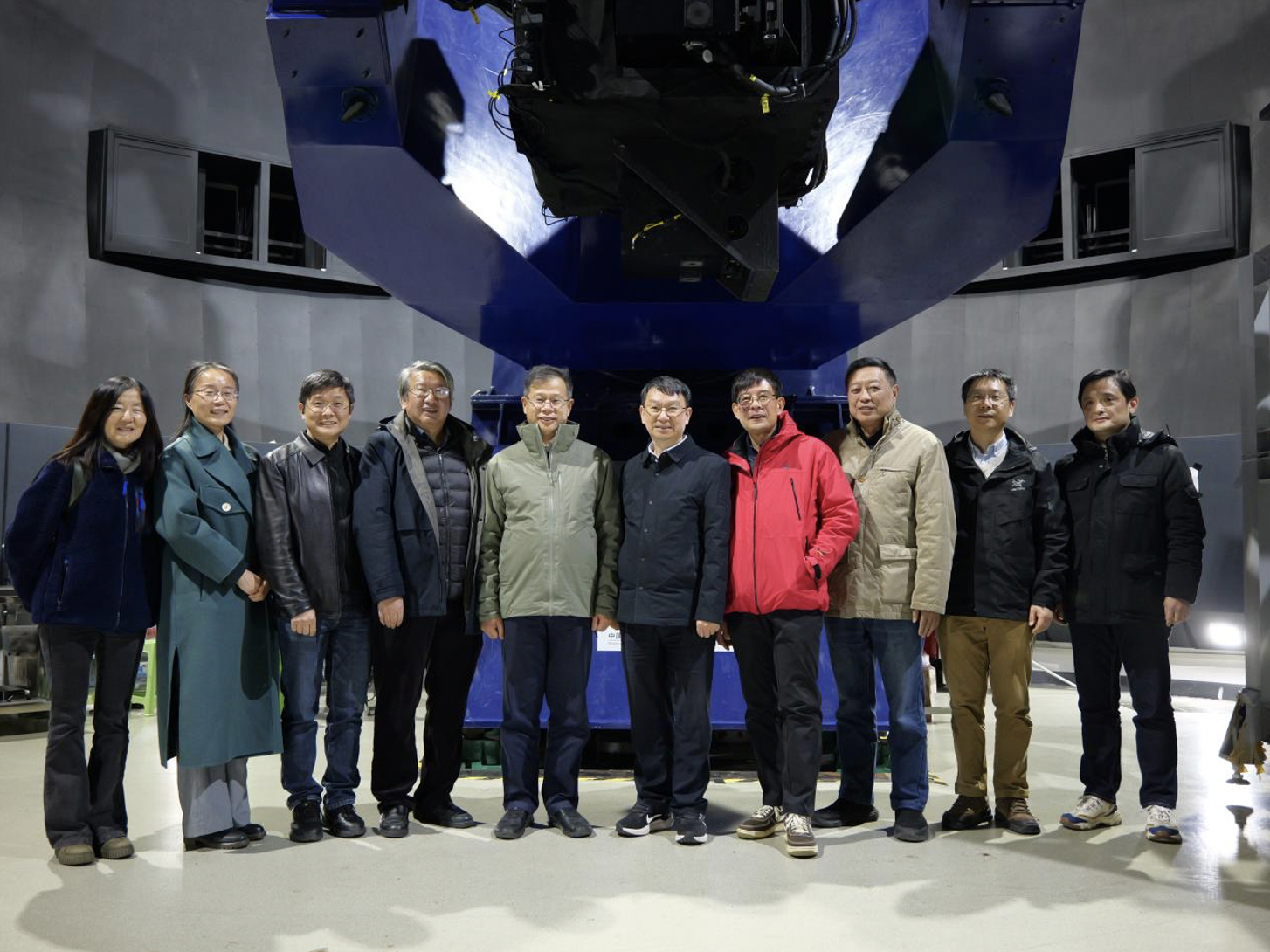
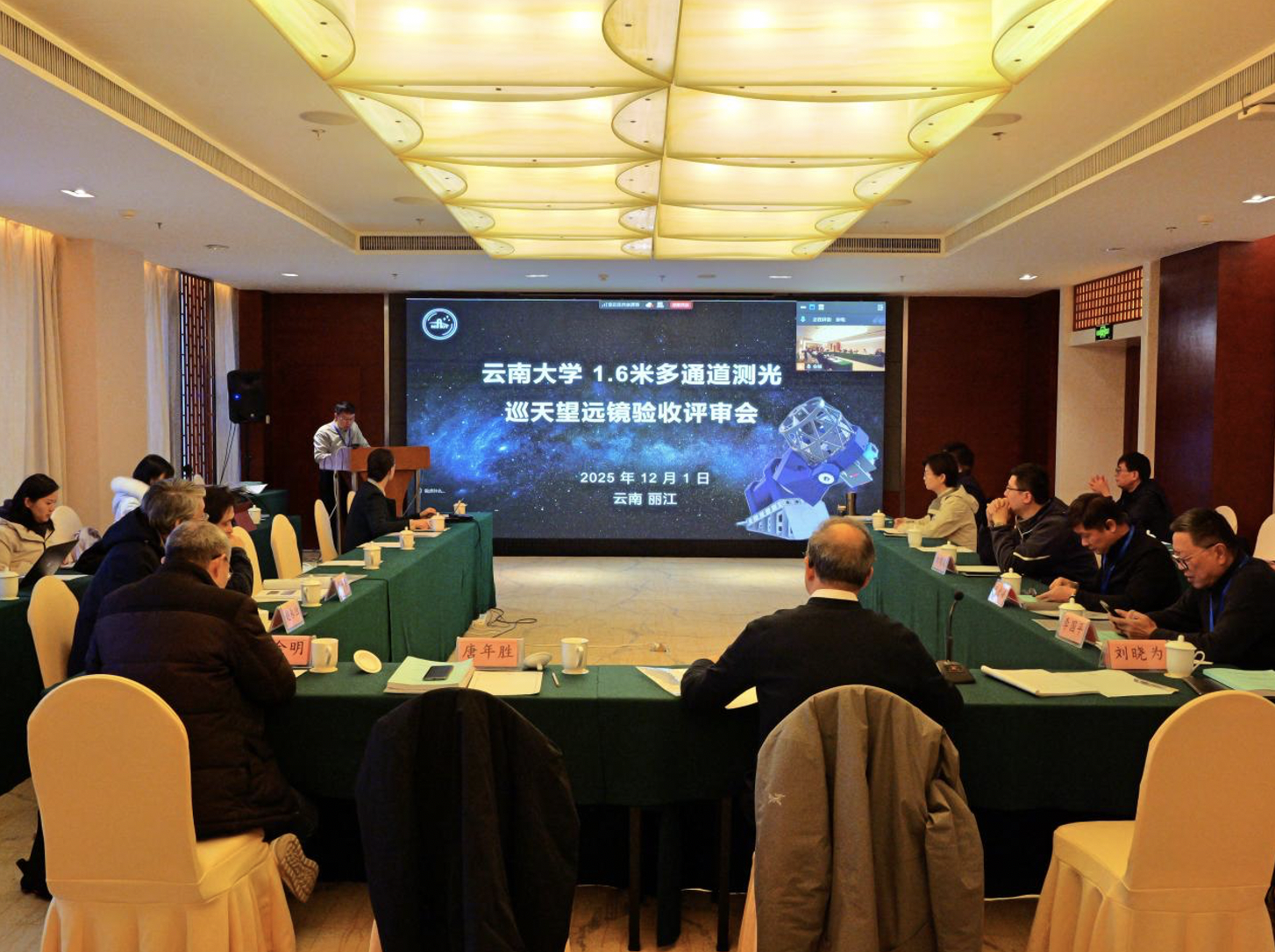



From November 30 to December 1, 2025, the “Acceptance Review Meeting for the Multi-channel Photometric Survey Telescope at Yunnan University” and the “Preliminary Acceptance Review Meeting for the Yellow- and Red-channel Mosaic Cameras of the Multi-channel Photometric Survey Telescope” were held at the Gaomeigu Astronomical Observatory in Lijiang. Experts from Shanghai JiaoTong University, the National Astronomical Observatories (NAOC), Yunnan Observatories (YNAO), Purple Mountain Observatory (PMO), Nanjing Institute of Astronomical Optics & Technology (NIAOT), Center For Space Utilization (CSU), Shanghai Institute of Technical Physics (SITP), Xi’an Institute of Optics and Precision Mechanics of the Chinese Academy of Sciences, and Yunnan University attended the meetings. The expert panels for the telescope acceptance review and the mosaic camera preliminary acceptance review were chaired by Academician Yipeng Jing of Shanghai JiaoTong University and Researcher Jinming Bai of Yunnan Observatories, respectively. Professor Niansheng Tang, Vice President of Yunnan University, attended the acceptance meeting and delivered important speeches on behalf of the university. Also attending the acceptance meeting was the Office for the “Double First-Class” Initiative of Yunnan University.
On the morning of November 30, the review panel heard the reports presented by the mosaic camera development team from NAOC, including “Development Report on the Mosaic Cameras for the Multi-channel Photometric Survey Telescope at Yunnan University”, “Test Report of the Yellow-channel Mosaic Camera”, “Test Report of the Red-channel Mosaic Camera”, and “On-site Test Report of the Mosaic Cameras”, and raised questions and held discussions on relevant technical details. The panel unanimously concluded that the development team has completed the development of the yellow- and red-channel mosaic cameras, as well as the laboratory tests and preliminary on-site tests, and that the overall performance meets the technical specifications stipulated in the contract. The panel recommended that the project team proceed as planned with subsequent upgrades and iterations and complete the final acceptance in due course.
On the afternoon of November 30, the experts reviewed and approved the “On-site Test Plan for the Multi-channel Photometric Survey Telescope at Yunnan University” and established an on-site test team. That night, following the approved plan, the test team carried out on-site tests of the telescope, resulting in a detailed test report.
On the morning of December 1, the expert panel heard the “Final Development Summary Report of the Multi-channel Photometric Survey Telescope” presented by the project team from NIAOT, as well as the test report delivered by the on-site test team. The experts also reviewed relevant technical documentation and archival materials. After thorough discussion and evaluation, the panel concluded that the project team has fulfilled the development tasks of the Multi-channel Photometric Survey Telescope in accordance with the cooperation agreement, that all performance indicators meet the agreed specifications, and unanimously agreed that the Multi-channel Photometric Survey Telescope has successfully passed the acceptance review.
The Multi-channel Photometric Survey Telescope (Mephisto) is a major scientific research facility under Yunnan University’s “Double First-Class” initiative. It is the world’s first survey telescope that combines a large field of view, large aperture, multi-channel high-precision imaging, and is capable of capturing “true-color documentaries” of the dynamic universe. The telescope has a 1.6-m primary mirror and a 3.14-square-degree field of view. Its unique advantage lies in its ability to obtain images in three bands simultaneously, providing ultra-high-precision photometry and color information of celestial objects.
The project was officially launched in January 2018. fter years of dedicated development and overcoming the impact of the COVID-19 pandemic, a pilot system covering one quarter of the full field of view was installed on site at the Gaomeigu Station in Lijiang in October 2022, achieving first light in the blue and red channels. In December 2023, the telescope obtained its first celestial images with simultaneous blue, yellow, and red-channel exposures and released the world’s first true-color sky map, which received extensive media coverage and drew great attention from both the astronomical community and the general public. The achievement “Mephisto Survey Telescope Releases the World’s First True-color Sky Map” was selected as one of the “Top Ten Scientific and Technological Advances of Yunnan University in 2023”. Since 2024, the pilot survey has been carried out, completing multi-band survey of more than 1,000 square degrees of sky. The telescope has conducted multi-epoch, multi-band simultaneous observations of standard stars (and calibration fields), as well as a variety of variable and transient sources, including supernovae, candidate tidal disruption events, active galactic nuclei (AGNs), variable stars, and nearby galaxies. These efforts have supported multiple international collaborations and scientific research projects. Based on the data obtained from the pilot survey, the project team has produced its first series of important scientific results, with several papers published in leading international astronomy journals, and has issued more than 50 GCN circulars on rapidly evolving transients. Since September 2025, the full-field optical system of the telescope and all three mosaic cameras have been installed on site, and comprehensive optical fine-tuning of the whole system is currently underway.
The completion and successful acceptance of the Multi-channel Photometric Survey Telescope (Mephisto) mark that Yunnan University now operates one of the most advanced wide-field optical survey facilities among Chinese universities, comparable to those at top international institutions. This greatly enhances the influence and original innovative capacity of Yunnan University’s astronomy program, and provides a solid foundation and powerful support for building a world-class astronomical research center and training the next generation of high-level observational and experimental astronomers.
