云南大学中国西南天文研究所宇宙学团队首次将弱引力透镜峰值陡度统计应用于真实观测数据
The first application of weak gravitational lensing peak steepness statistics to real observational data
弱引力透镜效应起源于宇宙大尺度结构对光线的引力偏折,其造成背景星系光的分布产生微弱畸变。通过对大样本星系的高精度形状测量和统计分析,利用弱引力透镜信号,天文学家可以绘制宇宙中物质分布,进而开展宇宙学研究,限制暗物质暗能量性质。作为一种重要的提取非高斯信息的统计方法,近年来,弱引力透镜峰值统计已成为各大巡天广泛应用的分析手段,中国西南天文研究所宇宙学团队是相关前沿领域国际重要的团队之一。
以往的峰值统计均集中于高度的统计。在近期的研究中,中国西南天文研究所宇宙学团队将其拓展至峰值陡度统计,即测量峰的二阶导数,该物理量反映了峰的陡峭程度,如图1所示。团队建立了相应的分析方法和统计理论模型。这一新的统计对暗晕物质分布具有独特的敏感性,而后者蕴含着暗物质性质、重子反馈等重要物理信息,因此峰值陡度统计在弱引力透镜宇宙学研究中具有重要的科学价值。
基于日本昴星团望远镜(Subaru Telescope)搭载的超广角相机(Hyper Suprime-Cam,简称HSC)第一年星系剪切测量数据,宇宙学团队首次利用观测数据开展了峰值陡度统计分析,成功地限制了宇宙学参数和暗物质晕的密度轮廓,如图2所示。与纯冷暗物质模拟相比较,观测分析结果显示暗晕物质分布倾向于更小的聚度值,指向强的重子反馈效应,这与近期多项其它观测分析相一致。该工作充分显示了峰值陡度统计的可行性和重要性,为研究宇宙大尺度结构中的重子反馈效应和暗物质性质提供了全新的观测统计手段。随着下一代弱引力透镜巡天项目如欧几里得卫星(Euclid),薇拉·鲁宾天文台巡天(Vera C. Rubin Observatory Legacy Survey of Space and Time, LSST),南希·格雷斯·罗曼太空望远镜(Nancy Grace Roman Space Telescope)和中国空间站巡天空间望远镜(Chinese Space-station Survey Telescope, CSST)等大规模巡天数据的积累,峰值陡度统计将在精确宇宙学研究中发挥更加重要的作用,为限制宇宙学参数,重子反馈过程,揭示暗物质和暗能量的本质提供关键观测约束。
研究成果发表于《天体物理学杂志》(The Astrophysical Journal,https://iopscience.iop.org/article/10.3847/1538-4357/ae9eb3)。博士后李梓炜为第一作者,范祖辉教授和刘项琨教授为通讯作者。该工作得到了国家自然科学基金、中国载人航天工程等多项基金资助。
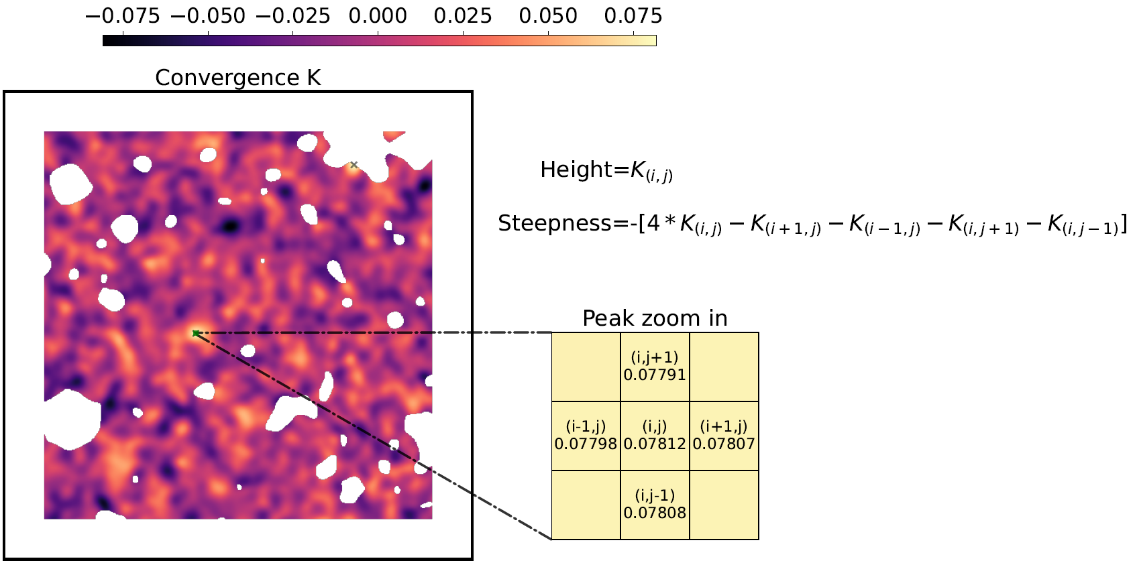
图1. 从HSC星系形状星表中重构出的弱引力透镜会聚图及图中相应的峰点和高度、陡度的计算。
Figure 1. Weak gravitational lensing convergence map reconstructed from the HSC shear catalog, along with the corresponding peaks and the estimation of peak height and steepness.
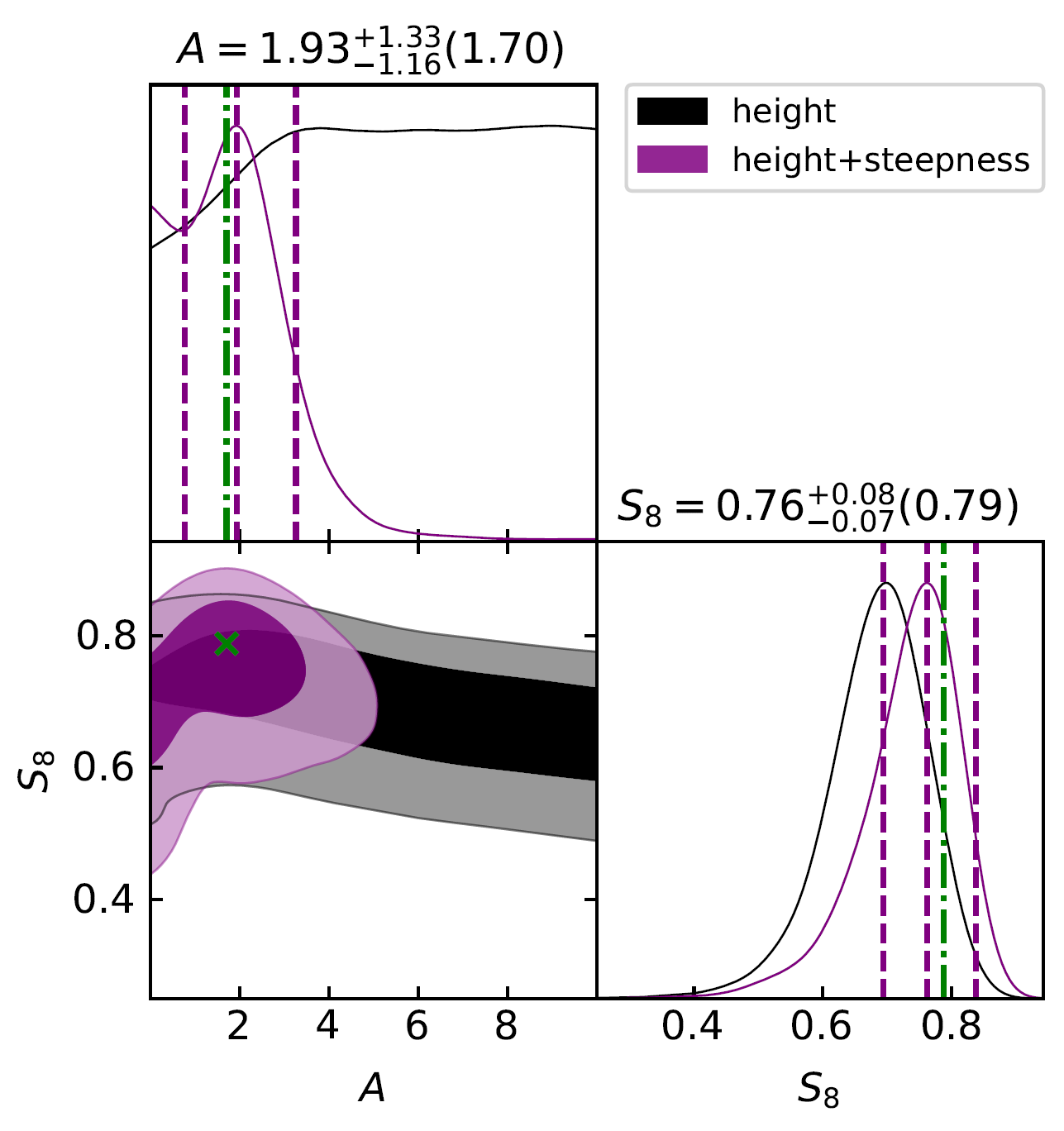
图2. 使用HSC弱引力透镜峰值高度和陡度统计对宇宙学参数S8和晕聚度参数A的限制结果。在加入了峰值陡度统计后,对参数A的限制能力明显提升。
Figure 2. Results of constraining the cosmological parameter S8 and the amplitude parameter A of the halo mass-concentration relation using HSC weak lensing peak height and steepness statistics; the inclusion of peak steepness statistics leads to a significant improvement in the constraint on the parameter A.

Weak lensing (WL) effects arise from gravitational light bending by the large-scale structures in the Universe. It results in tiny distortions on the observed light distributions of background galaxies. By accurately measuring a large sample of faraway galaxies, WL effects enable the reconstruction of the foreground matter distribution statistically for cosmological studies, including probing the nature of dark matter and dark energy. WL peak statistics has been recognized and widely applied in different surveys as an important means to extract the non-Gaussian information of the cosmic structures. The cosmology group of SWIFAR is one of the key groups in this area internationally.
The past WL peak studies have focused on peak height statistics. Recently, the SWIFAR cosmology group has extended the analyses to WL peak steepness statistics, i.e., to measure the second derivatives of peaks that reflect how steep the peaks are, as shown in Figure 1, and established the analyzing method and a theoretical model. Comparing to peak height statistics, this new analysis is particularly sensitive to the matter distribution of halos, which encodes important information of the nature of dark matter and baryonic feedback, and thus can provide important added value to WL cosmological studies.
Using the first-year HSC shear catalog, the SWIFAR cosmology group performed the first application of the WL peak steepness analyses to observational data, and successfully obtained the constraints on cosmological parameters and the amplitude A of the halo mass-concentration relation, presented in Figure 2. The results reveal a lower A value in comparison with that from cold-dark-matter-only simulations, pointing to strong baryonic feedback, in consistent with several other observational analyses using different observables. This study demonstrates well the feasibility and the importance of the WL peak steepness statistics, providing a new means to probe how the baryonic feedback and the nature of dark matter affect the cosmic structures. With the new generation of WL surveys being in operation one by one, including Euclid, LSST, Roman and CSST, the WL steepness statistics will expectedly play ever more important roles in WL cosmology.
This study has been published in The Astrophysical Journal (https://iopscience.iop.org/article/10.3847/1538-4357/ae9eb3). Ziwei Li, a postdoctoral fellow of SWIFAR, is the first author, and Profs. Zuhui Fan and Xiangkun Liu are the corresponding authors. The research was supported by the grants from the National Natural Science Foundation of China and the grants from China Manned Space Projects.
