云南大学中国西南天文研究所团队发现银河系有趣的U形年龄轮廓
The intriguing U-shaped age profile of the Milky Way discovered by the SWIFAR team at YNU
近日,云南大学中国西南天文研究所连建辉教授团队在《自然天文学》杂志上发表了一项重要研究成果,发现银河系从内向外的年龄并不是一直降低,而是呈现出一个十分有趣的“U形”年龄分布。文章链接:https://rdcu.be/fnkr4 。
具体来说,银河系的恒星年龄并不是如预期单调地从内向外变年轻,而是先下降后上升。研究显示,从银河系的中心到距离中心约3.6万光年的区域(我们的太阳大约在2.6万光年处),恒星的平均年龄在逐渐降低,即越往外围恒星越年轻。然而,在3.6万光年之外的外围区域,情况发生了转折:恒星的年龄反而开始回升,越往外越古老。到了约4.5万光年以外的极远处,恒星年龄基本稳定在50亿年左右。这种从中心向外“年老—年轻—再年老”的起伏构成了观测到的U形年龄轮廓。
为什么会出现这种特征?研究人员分析后认为,这并非因为银河系是从外向内形成,而是因为星系盘内的恒星会搬家——即恒星径向迁移造成的。银河系的盘面在约3.6万光年以内的区域,是恒星批量诞生的工厂,但在这个半径以外,恒星形成活动基本停止。我们今天在更外围看到的古老恒星,其实是更早时期在盘的内侧诞生,然后通过与星系的旋臂、中心棒等结构的引力相互作用,轨道半径逐步增加,逐渐迁移到了如今偏远的位置。银河系的观测为这一理论猜测提供了直接的观测证据。而测量出的年龄U形特征也为这种迁移的速率提供了直接的限制,且推算出的速度与此前其他方法得到的结果基本吻合。
这项研究不仅让我们更深入地理解我们的家园星系如何成长和扩张,其所发展的方法还有望应用于遥远的河外星系,帮助天文学家测量其他星系中恒星的迁移速度,从而更好地理解星系演化的普遍规律。
这项研究得到了国家自然科学基金、国家重点研发计划、云南省科技厅和巡天科学重点实验室的支持。
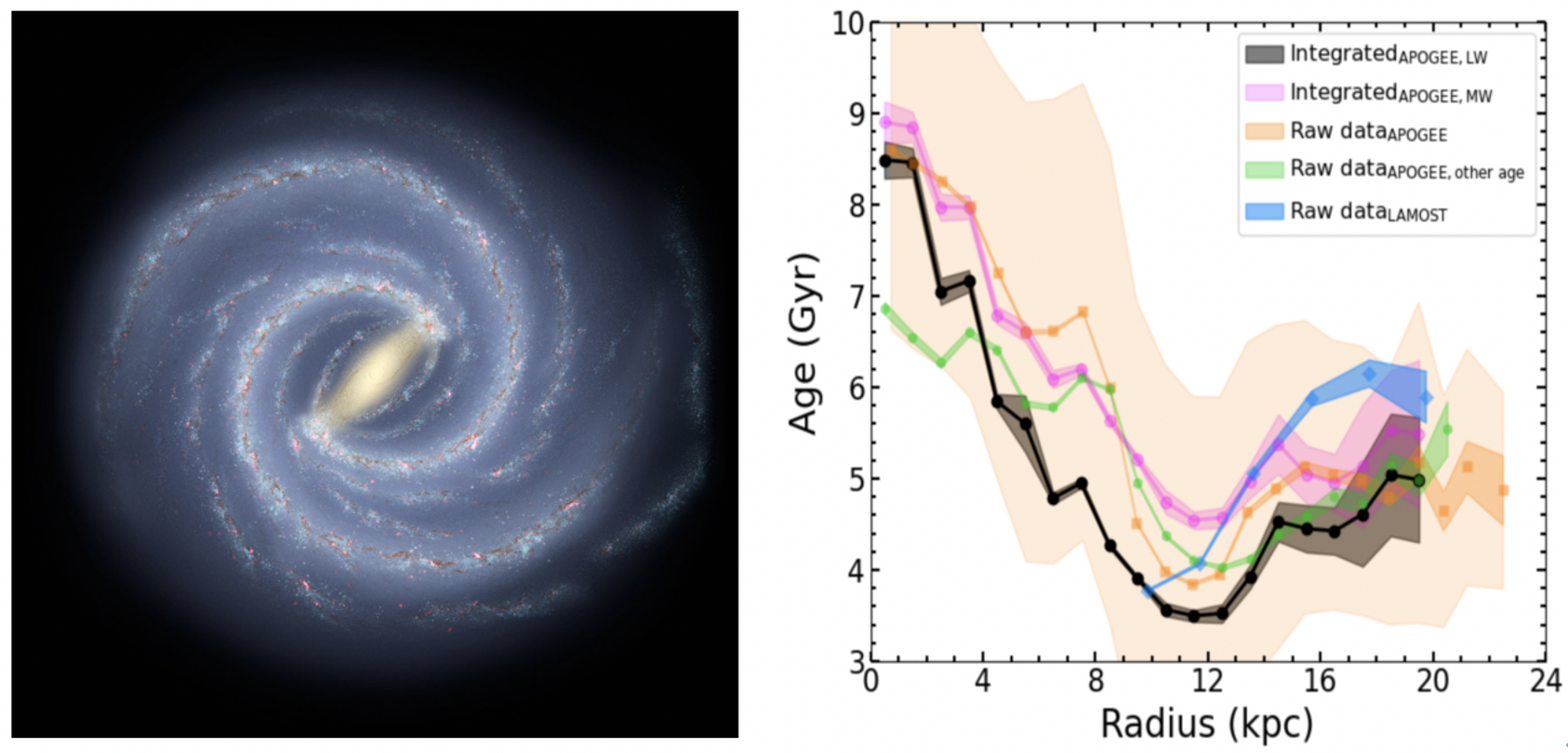
图1.左图:银河系河外视角想象图(来自美国宇航局)。右图:银河系年龄轮廓。横坐标半径单位为千秒差距(kpc),1kpc≈3260光年,纵坐标年龄单位为10亿年。
Figure 1. Left: Artist's conception of the Milky Way viewed from extra-galactic perspective (credit: NASA). Right: Age profile of the Milky Way. The horizontal axis represents radius in kiloparsecs (kpc), where 1 kpc ≈ 3260 light-years; the vertical axis represents age in billions of years.

A recent study led by Professor Jianhui Lian's team from the South-Western Institute for Astronomy Research at Yunnan University, published in Nature Astronomy, has revealed that the age of stars in the Milky Way does not simply decrease monotonically from the inside out, but instead exhibits an intriguing "U-shaped" age profile.
Specifically, the stellar ages in the Milky Way do not become steadily younger from the inner to the outer regions as expected, but rather decrease first and then increase. The study shows that from the Galactic center to a distance of about 36,000 light-years (our Sun is located roughly at 26,000 light-years), the average age of stars gradually declines, meaning that stars become younger toward the outskirts. However, beyond 36,000 light-years, the trend reverses: stellar ages start to rise again, with stars farther out being older. At the extreme outer regions beyond approximately 45,000 light-years, stellar ages stabilize at around 5 billion years. This undulation from the center outward—old, young, then old again—constitutes the observed U-shaped age profile.
Why does such a feature emerge? The researchers propose that it is not because the Milky Way formed from the outside in, but rather because stars in the Galactic disk "move around"—a phenomenon named stellar radial migration. One can imagine that the region within roughly 36,000 light-years of the Milky Way's disk acts as a factory for the bulk formation of stars, but beyond this radius, star formation activity essentially ceases. The ancient stars we see today in the outer regions were actually born earlier in the inner part of the disk, and later gradually migrated to their current remote locations through gravitational interactions with spiral arms, the central bar, and other structures, causing their orbital radii to increase over time. The observations of the Milky Way provide direct observational evidence for this theoretical hypothesis. The measured U-shaped age characteristic also places direct constraints on the rate of this migration, and the derived speed is broadly consistent with results obtained by other methods.
This research not only deepens our understanding of how our home galaxy grows and expands, but the developed methodology also holds promise for application to distant extragalactic systems, helping astronomers measure the migration speeds of stars in other galaxies and thus better understand the universal laws of galaxy evolution.
The study was supported by the National Natural Science Foundation of China, the National Key Research and Development Program, the Yunnan Provincial Department of Science and Technology, and the Key Laboratory for Sky Survey Science.
