云南大学团队中国西南天文研究所参与HETDEX巡天发现大样本Lyα星云
Astronomers Thought the Early Universe Was Full of Hydrogen. Now They’ve Found It
Lyα星云(Lyman-alpha nebulae)是分布在星系周围的大尺度弥散氢气结构,是研究宇宙正午时期(z≈2)气体供给、星系形成及黑洞反馈过程的重要观测窗口。然而,由于其表面亮度低且尺度跨度大,长期以来仅发现少量个例,其统计性质与形成机制仍缺乏系统认识。
HETDEX巡天是一个无预选源的大天区积分视场光谱巡天项目,依托美国德州10米霍比-埃伯利望远镜,可在大范围天空中同时获取数万条光谱,实现对宇宙三维结构的系统测绘。该巡天不仅覆盖星系本身,还记录星系之间的弥散气体信息,为研究Lyα星云提供了独特数据基础。
云南大学中国西南天文研究所活动星系核团队参与的国际合作研究,基于HETDEX巡天数据系统搜寻Lyα星云,在早期宇宙中发现超过3.3万个此类结构,是此前已知数量的十倍以上。研究表明,这类气体结构在宇宙正午时期并非罕见,而是普遍存在,为理解星系生长所需气体来源提供了关键观测证据。
该研究成果已发表于 《天体物理学杂志》(https://iopscience.iop.org/article/10.3847/1538-4357/ae44f3 )。云南大学刘辰旭副研究员为论文作者之一,合作单位包括德克萨斯大学奥斯汀分校、麦克唐纳天文台等国际研究机构。
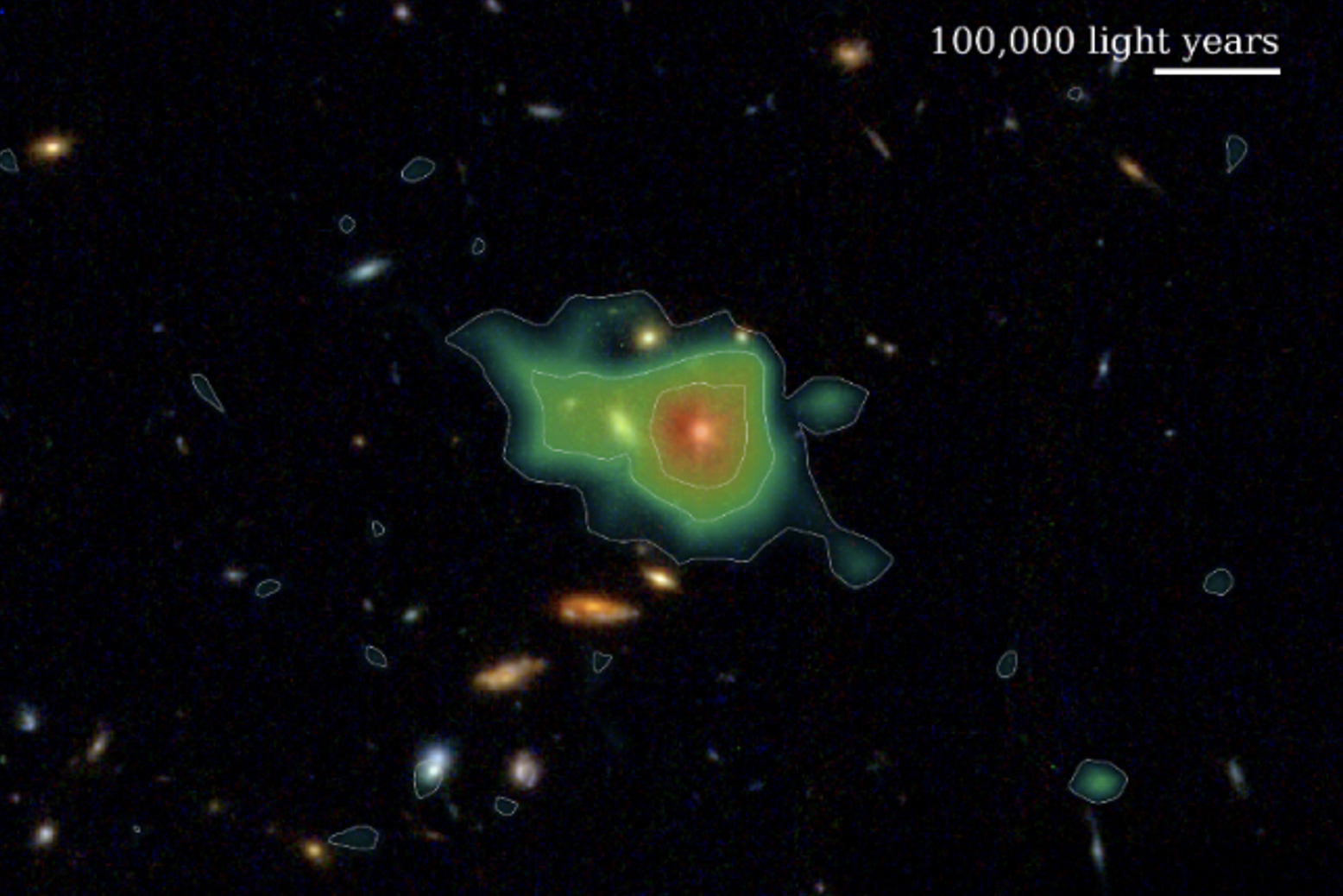
图1. 基于 Hobby–Eberly Telescope Dark Energy Experiment(HETDEX)巡天数据发现的一个典型Lyα星云示例,并叠加在 James Webb Space Telescope 深度成像背景上。该系统位于约113亿年前,其发光来自内部多个星系的综合辐射,红色区域表示最亮部分。HETDEX巡天将此类结构的已知数量从约3000个提升至超过33000个。图像来源:Erin Mentuch Cooper(HETDEX);JWST图像:NASA/ESA/CSA/STScI。
下列英文报道转自HETDEX项目组(https://hetdex.org/astronomers-thought-the-early-universe-was-full-of-hydrogen-now-theyve-found-it/ )。

Astronomers using data from the Hobby–Eberly Telescope Dark Energy Experiment (HETDEX) have discovered tens of thousands of gigantic hydrogen gas halos, called “Lyman-alpha nebulae,” surrounding galaxies 10 billion to 12 billion years ago. Known as Cosmic Noon, this is an epoch in the early universe when galaxies were growing their fastest. To spur this growth, they would have needed access to vast reservoirs of hydrogen gas, a key building block for stars. However, until recently, astronomers had only found a handful of these essential structures.
A new study published in The Astrophysical Journal has now increased the known number of hydrogen gas halos by a factor of ten: from roughly 3,000 to over 33,000. This confirms suspicions that they are not rare curiosities. The study also increases the range of known sizes, providing a more representative sample for astronomers to study as they continue to tease out the origin and evolution of the first galaxies.
“We’ve been analyzing the same handful of objects for the past 20 or so years,” said Erin Mentuch Cooper, HETDEX data manager and lead author on the study. “HETDEX is letting us find many more of these halos and measure their shapes and sizes. It has really allowed us to create an amazing statistical catalogue.”
Hydrogen gas is notoriously hard to detect because it doesn’t generate its own light. However, if it’s near an object that’s throwing off a lot of energy – say, a galaxy or group of galaxies full of UV-emitting stars – that energy can cause the hydrogen to glow. To detect this, you need to dedicate a lot of time on precise instruments, which are often in high demand.
While previous astronomical surveys have found some of these halos, their instruments were only able to pick up on the brightest, most extreme examples. And targeted observations of early galaxies are usually so zoomed in that they cut off all but the smallest halos. As a result, everything in between the little guys and the big honkers has remained elusive.
Observations from HETDEX are starting to fill in this gap. Using the Hobby-Eberly Telescope at McDonald Observatory, it is charting the position of over one million galaxies in its quest to understand dark energy. “We’ve captured nearly half a petabyte of data on not only these galaxies but the regions in between,” said Karl Gebhardt, HETDEX principal investigator, chair of The University of Texas at Austin’s astronomy department, and co-author on the paper. “Our observations cover a region of the sky measuring over 2,000 full Moons. The scope is enormous and unprecedented.”
“The Hobby-Eberly Telescope is one of the largest in the world,” added Dustin Davis, a postdoctoral fellow at UT Austin, a HETDEX scientist, and co-author on the study. “And the instrument HETDEX uses produces 100,000 spectra in each observation. So, we have huge amounts of data and there are all kinds of neat, fun, weird things waiting for us to find.”
The newly revealed halos measure from tens of thousands to hundreds of thousands of light years across. Some are as simple as a football-shaped cloud surrounding a single galaxy. Others are sprawling, irregular blobs containing multiple galaxies. “Those are the fun ones,” said Mentuch Cooper. “They look like giant amoebas with tendrils extending into space.”
To find them, the team selected the 70,000 brightest of the over 1.6 million early galaxies that have been identified by HETDEX so far. With the help of supercomputers at the Texas Advanced Computing Center, they looked to see how many of these showed evidence of a surrounding halo: a compact central region of hydrogen and a thinner cloud extending beyond it.
Nearly half did. What’s more, this fraction is likely an underestimate, explained Mentuch Cooper. “We suspect the faintest systems simply aren’t bright enough to fully reveal how large they are.”
The team hopes their discovery will help others study the early universe: how its structures evolved, the distribution of matter, the movement of objects, and more. With 33,000 halos to study, the problem will no longer be where to find them, but which one to choose.
“There are various models for galaxies in this epoch that largely work and seem to make sense, but there are gaps and holes,” explained Davis. “Now we can focus in on individual halos and see at a greater detail the physics and mechanics of what's going on. And then we can fix or throw out the models and try again.”
