云南大学团队助力中国“天眼”,揭示快速射电暴双星起源
Evidence for a Binary Origin of a Repeating Fast Radio Burst from FAST Observations
快速射电暴(fast radio bursts, FRBs)是宇宙中最神秘的射电爆发现象之一,其持续时间仅数毫秒,却释放出相当于太阳一整周的能量。自2007年首次发现以来,快速射电暴的起源一直是天体物理学的重大未解之谜。科学界普遍认为快速射电暴可能与中子星等致密天体相关,而部分重复快速射电暴所呈现的复杂磁化环境,则暗示其中心引擎可能位于双星系统中。然而,长期以来一直缺乏这一假说直接观测的证据。
2026年1月16日,国际顶级学术期刊Science杂志在线发表利用中国500米口径球面射电望远镜(FAST,“中国天眼”)对重复快速射电暴 FRB 20220529 进行长达2.2年的持续观测成果。研究团队首次完整记录了该暴源法拉第旋转量(rotation measure, RM)剧烈跃变并随后回落的全过程,为快速射电暴双星起源提供了迄今为止最强有力的观测证据。这一现象在目前所有发现的快速射电暴中尚属首次,为理解快速射电暴的物理环境和爆发机制提供了宝贵数据。
研究团队对FRB 20220529所有可探测爆发事件开展了高精度偏振测量,并据此构建了该源法拉第旋转量随时间变化的完整演化。分析结果显示,在此前约一年半的常规观测期间,其法拉第旋转量始终处于接近零的低值范围,仅呈现数百弧度每平方米的微弱波动,反映出传播路径上的磁化等离子体环境总体平稳且贡献有限。然而在2023年末,该暴源的法拉第旋转量出现了突发性的显著增强,峰值接近2000弧度每平方米,并在随后数周内连续、平滑地衰减,最终恢复至此前的稳定状态。这一变化过程在幅度、时间尺度及其前后环境的一致性方面均表现出高度的独特性,表明法拉第旋转的主导来源不是长期稳定的星际介质,而应归因于暴源附近的一次短暂而强烈的磁化等离子体注入事件。结合对多种可能物理机制的系统排查,研究团队最终指出,该现象最合理的解释是双星系统中伴星发生剧烈物质抛射,对观测视线产生了短时而显著的磁化影响。
在这一重要成果中,云南大学中国西南天文研究所杨元培副教授作为论文共同第一作者,牵头完成了关键的理论解释与物理模型构建工作,首次提出了伴星耀发对法拉第旋转量跃变贡献的物理图像,并通过系统分析排除了其他起源的可能解释,成功揭示了观测现象背后的物理机制。这一模型不仅重现了FRB 20220529中法拉第旋转量的“跃变—回落”现象,也为快速射电暴起源于双星系统提供了相应的理论依据。云南大学团队在理论分析、模型建立及物理机制阐释方面发挥了核心作用,为该成果的科学价值提供了重要的支撑。通过精密观测与理论分析的结合,推动了快速射电暴研究进入新的发展阶段,也充分体现了中国天文学在国际前沿研究中的实力与影响力。
本项目由国内外多家科研机构合作,包括中国科学院紫金山天文台、中国科学技术大学、澳大利亚联邦科学与工业研究组织、云南大学、中国科学院国家天文台,以及香港大学等。论文共同第一作者为中国科学院紫金山天文台李晔副研究员、张松波博士,云南大学杨元培副教授;共同通讯作者为中国科学院紫金山天文台吴雪峰研究员、中国科学院国家天文台朱炜玮研究员、姜鹏研究员,香港大学张冰教授。
发表论文链接:https://www.science.org/eprint/6MNDXXNXNE2WV4J9YYIA/full?activationRedirect=/doi/full/10.1126/science.adq3225
新华社:https://h.xinhuaxmt.com/vh512/share/12926711?docid=12926711&newstype=1001&d=1352514&channel=weixin&time=1768538218538
人民日报:https://www.peopleapp.com/column/30051228450-500007310086
央视新闻:https://content-static.cctvnews.cctv.com/snow-book/video.html?item_id=18310077616881875046&t=1768551982480&toc_style_id=video_default&share_to=wechat&track_id=d614c8be-7513-464d-bad0-32d194c20d7e
光明日报:https://mp.weixin.qq.com/s/FHZZ5rZud94GXiuXUse0VA
中国新闻:https://m.chinanews.com/wap/detail/chs/zw/10552979.shtml
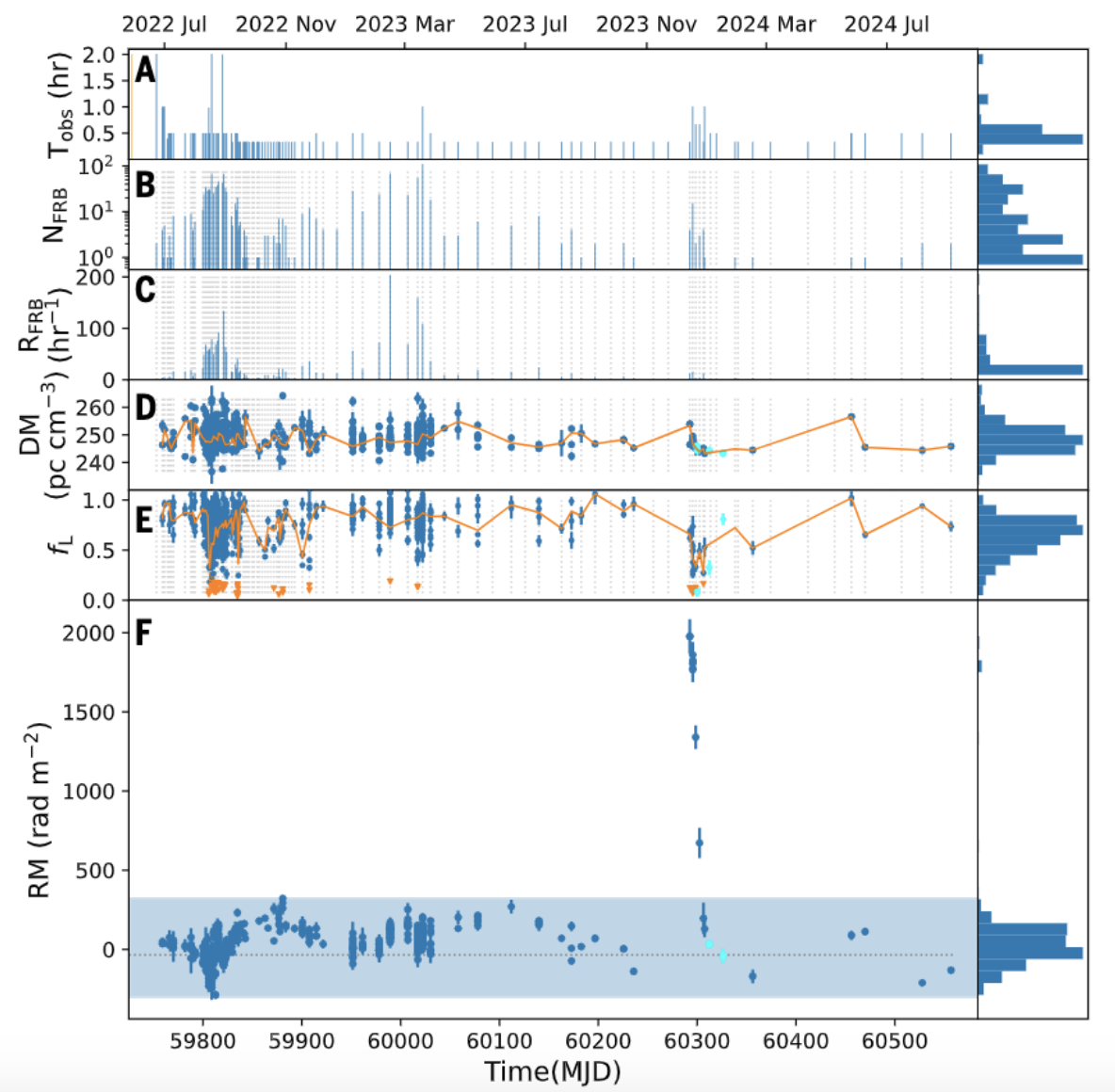
图1. 快速射电暴FRB 20220529的法拉第旋转量时间演化图。2023年底,该源的法拉第旋转量出现20倍的急剧跳变,随后在两周内回落至正常水平,清晰记录了磁化等离子体云穿过观测视线的全过程,为双星起源假说提供了直接证据。
Figure 1. Time evolution of the Faraday rotation measure of FRB 20220529. Toward the end of 2023, the rotation measure of the source exhibited an abrupt increase by a factor of 20, followed by a return to its nominal level within approximately two weeks. This evolution captures the full passage of a magnetized plasma cloud across the line of sight, providing direct observational evidence in support of a binary-origin scenario.
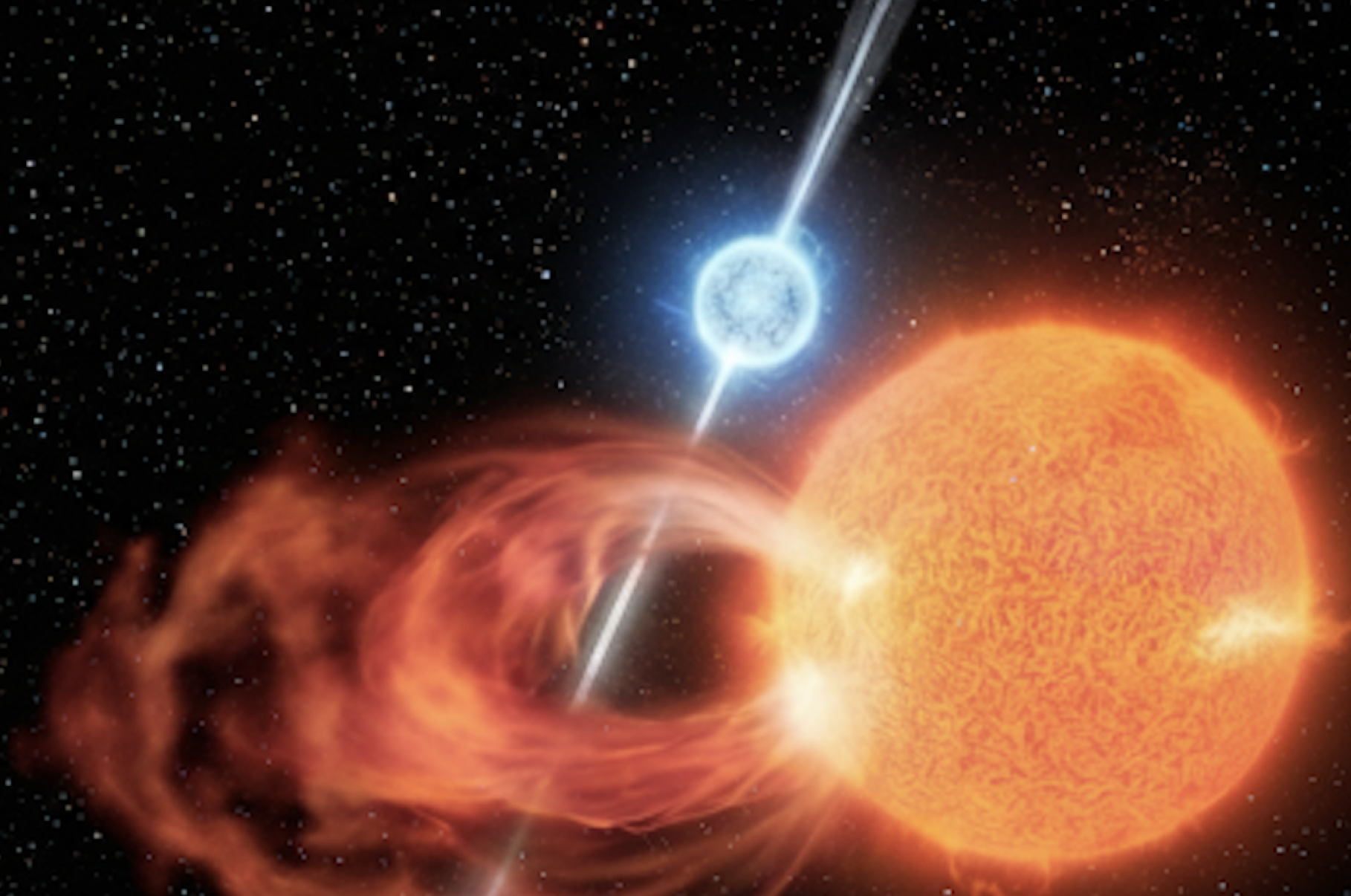
图2. 双星系统中快速射电暴穿过伴星抛射物的示意图。
Figure 2. Schematic illustration of a fast radio burst propagating through ejecta from the companion star in a binary system.

Fast radio bursts (FRBs) are among the most enigmatic transient radio phenomena in the Universe. Lasting only a few milliseconds, they can release an amount of energy comparable to the total radiative output of the Sun over an entire week. Since their first discovery in 2007, the physical origin of FRBs has remained one of the major unsolved problems in astrophysics. It is widely accepted that FRBs are associated with compact objects such as neutron stars, and the complex magnetized environments observed in some repeating FRBs further suggest that their central engines may reside in binary systems. However, until recently, direct observational evidence supporting this hypothesis had been lacking.
On January 16, 2026, the Science journal published online the results of a 2.2-year long monitoring campaign of the repeating FRB 20220529 conducted with the Five-hundred-meter Aperture Spherical radio Telescope (FAST), also known as the “China Sky Eye”. For the first time, the research team captured the complete temporal evolution of a dramatic jump and subsequent decay in the Faraday rotation measure (RM) of a repeating FRB. This unprecedented observation provides the strongest observational evidence to date for a binary origin of fast radio bursts. Such a phenomenon has not previously been reported in any known FRB source and offers invaluable data for understanding the physical environments and emission mechanisms of FRBs.
The research team conducted high-precision polarization measurements for all detectable burst events from FRB 20220529 and, on this basis, reconstructed the complete temporal evolution of the source’s Faraday rotation measure. The analysis shows that during approximately one and a half years of routine monitoring, the rotation measure remained at a consistently low level near zero, exhibiting only weak fluctuations at the level of a few hundred rad m⁻². This behavior indicates that the magnetized plasma along the line of sight was largely stable and contributed only modestly to the observed Faraday rotation. In contrast, toward the end of 2023, the rotation measure underwent a sudden and pronounced enhancement, reaching peak values close to 2000 rad m⁻², followed by a continuous and smooth decay over the subsequent weeks, eventually returning to its previous quiescent state. The exceptional nature of this event—characterized by its large amplitude, well-defined temporal evolution, and the consistency of the surrounding observational conditions—strongly suggests that the dominant contribution to the Faraday rotation did not arise from the long-term, stable interstellar medium. Instead, it is most naturally attributed to a short-lived, highly magnetized plasma injection occurring in the immediate vicinity of the FRB source. By systematically evaluating and ruling out a range of alternative physical mechanisms, the team concludes that the most plausible explanation for this phenomenon is a violent mass-ejection event from a companion star in a binary system, which produced a transient but substantial magnetization along the line of sight.
In this major discovery, Associate Professor Yuan-Pei Yang from the South-Western Institute For Astronomy Research (SWIFAR) at Yunnan University, as a co-first author of the paper, led the key theoretical interpretation and physical modeling of the observed phenomenon. He was the first to propose a physical scenario in which flaring activity from a companion star contributes to the observed polarization variability, and through systematic analysis, he ruled out alternative origin scenarios. This work successfully elucidates the physical mechanism underlying the observed behavior. The proposed model not only reproduces the observed “jump–decay” evolution of the Faraday rotation measure in FRB 20220529, but also provides strong theoretical support for the binary-system origin of fast radio bursts. The Yunnan University team played a central role in the theoretical analysis, model construction, and physical interpretation, providing critical support for the scientific significance of this result. By combining high-precision observations with rigorous theoretical analysis, this work marks a significant step forward in FRB research and highlights the growing strength and international impact of Chinese astronomy at the forefront of astrophysical discovery.
This study is the result of collaboration among multiple research institutions in China and abroad, including the Purple Mountain Observatory of the Chinese Academy of Sciences, the University of Science and Technology of China, the Commonwealth Scientific and Industrial Research Organisation (CSIRO) of Australia, Yunnan University, the National Astronomical Observatories of China, the University of Hong Kong, and other institutions. The co-first authors of the paper are Associate Researcher Ye Li and Dr. Songbo Zhang (Purple Mountain Observatory), and Associate Professor Yuan-Pei Yang (Yunnan University). The corresponding authors are Profs. Xuefeng Wu (Purple Mountain Observatory), Weiwei Zhu and Peng Jiang (National Astronomical Observatories), and Bing Zhang (University of Hong Kong).
Publication: https://www.science.org/eprint/6MNDXXNXNE2WV4J9YYIA/full?activationRedirect=/doi/full/10.1126/science.adq3225
Xinhua News:https://h.xinhuaxmt.com/vh512/share/12926711?docid=12926711&newstype=1001&d=1352514&channel=weixin&time=1768538218538
People’s Daily:https://www.peopleapp.com/column/30051228450-500007310086
CCTV News:https://content-static.cctvnews.cctv.com/snow-book/video.html?item_id=18310077616881875046&t=1768551982480&toc_style_id=video_default&share_to=wechat&track_id=d614c8be-7513-464d-bad0-32d194c20d7e
Guangming Daily:https://mp.weixin.qq.com/s/FHZZ5rZud94GXiuXUse0VA
China News:https://m.chinanews.com/wap/detail/chs/zw/10552979.shtml
